Best Keyboard for Students in 2026: Fast, Durable, and Backpack-Ready
In 2026, a student's office is wherever there’s a flat surface—a dorm room desk, a library booth, or even a tray table on a bus. But while student life is mobile, the built-in keyboards on many laptops are "mushy" and tiring to type on for long essays. The **best keyboard for students** must more than just a peripheral; it must be **Durable** (to survive being tossed in a backpack), **Compact** (to fit on tiny library desks), and **Ergonomic** (to prevent wrist strain during late-night study sessions).
We've focused our research on keyboards that solve the specific problems of student life: **Limited desk space**, **Loud typing** in quiet libraries, and the need for **Multi-Device connectivity** (switching between your laptop and tablet). We prioritized models with **"Plug-and-Play" simplicity** and **Long Battery Life**. Whether you're a high-schooler, a med student, or a PhD candidate, these are the top-rated picks for staying productive from any location.
Top 8 Best Keyboards for Academic Success (Detailed Reviews)
1. Logitech Signature K650 – The Best for Homework Comfort
Logitech is the most trusted name in student gear for a reason. The K650 is designed for those who spend 8+ hours a day typing papers and want zero technical stress. It features a **Built-in Deep Cushion Palm Rest** that supports your wrists, preventing the fatigue that comes from cheap, flat keyboards. The keys are "Whisper Quiet," so you won't bother your roommate or fellow students in the library. It is "Plug-and-Play," meaning you just plug it in and it works instantly. It features a battery life of up to **3 years**, making it the most reliable tool on the market.
- Pros: Most comfortable built-in wrist rest, silent typing, 3-year battery life, affordable.
- Cons: Plastic build (not aluminum), non-detachable wrist rest (takes up more bag space).
Who should buy this: Remote students and those with a dedicated home-office desk who prioritize comfort above all else.
2. Apple Magic Keyboard (75% Layout) – The Slim iPad Partner
For Apple users, the Magic Keyboard is the definition of "minimalist power." It is remarkably thin (less than 0.5 inches) and weighs almost nothing. For a student, its best feature is its **Tidy 100% Integration**—there is no software to install and no bulk. It uses the same "Scissor Mechanism" found in the latest MacBooks for a consistent, high-speed typing feel. For 2026, it features an improved USB-C charging port and a battery that lasts for over a month on a single charge. It’s finished in a stunning aluminum that matches modern hardware perfectly.
- Pros: Thinnest highnd keyboard, perfect Apple ecosystem integration, very light, consistent feel.
- Cons: No backlighting, no multi-device pairing (one device at a time).
Who should buy this: iPad and Mac users who want a highnd, minimalist upgrade for taking notes in class.
3. Keychron K2 Pro – The "Mechanical" Powerhouse
Keychron has revolutionized the student world by making "Mechanical" keyboards easy to use. The K2 Pro features the tactile "click" that feels so much better than standard plastic keyboards. For a student, its best feature is that it is **Pre-Built and Hot-Swappable**. You don't need to be a tech-expert to use it—it works out of the box. But if a key ever breaks, you can just pop it out and put a new one in for $1. It features a 75% layout (includes arrow keys) and is 100% compatible with both Mac and Windows.
- Pros: Incredible tactical typing feel, customizable lighting, highly durable, Mac/Win compatible.
- Cons: Higher "profile" might require a separate wrist rest, uses more power (recharge weekly).
Who should buy this: Engineering, CS, and writing students who want a professional typing experience that lasts for years.
4. iClever BK08 Folding Keyboard – The "Backpack" King
The BK08 is a masterpiece of folding engineering. It folds into a package about the size of a large smartphone and weighs only 215 grams. For a mobile student, its best feature is the **Builtnd-in Touchpad** on the right side—this means you don't even need to carry a separate mouse! It is made of a high-density alloy that feels rugged and professional. For 2026, the hinges have been reinforced to survive over 100,000 "Folds." It connects instantly via Bluetooth and providing a surprisingly stable typing platform even on your lap.
- Pros: Folds into a pocket-sized tool, built-in mouse touchpad, durable metal hinges, very light.
- Cons: Smaller keys take time to learn, typing logic is standard but "split."
Who should buy this: Backpack-only students and those who study in cafes and libraries with tiny tables.
5. Logitech MX Keys Mini – The Productivity Pro
While a bit more expensive, the MX Keys Mini is the "Gold Standard" for serious academic work. It features "Spherically Dished" keys that match the shape of your fingertips, making you type faster and with fewer mistakes. For a student, its best feature is the **Hand-Detection Backlighting**—the keys light up as your hands approach, perfect for dark dorm rooms or night flights. It pairing with up to 3 devices, allowing you to switch between your laptop and tablet with one button.
- Pros: Best-in-class low-profile feel, smart backlighting, multi-device pairing, luxury build quality.
- Cons: Higher price tag, no height adjustment (fixed angle).
Who should buy this: Senior students and PhD candidates who spend 8+ hours a day typing and want the best possible investment for their career.
6. Royal Kludge RK61 – The Best Budget "Custom"
For under $50, the RK61 is the ultimate "Starter" mechanical keyboard for a student desk. It features a 60% layout (no arrow keys), meaning it is very small and leaves massive room for your books and mouse. For a student, its best feature is the **"Triple-Mode" connectivity**—it can connect via Bluetooth, wireless USB dongle, or USB-C cable. It is "Hot-Swappable," allowing you to change the buttons easily. It features stunning RGB lighting and a very solid, heavy feel.
- Pros: Cheapest professional "Triple-Mode" wireless pick, hot-swappable, very compact, colorful lighting.
- Cons: Learning the "60%" layout (using Fn for arrows) takes a week, plastic build.
Who should buy this: High-schoolers and hobbyists who want a "cool" mechanical look and more desk space for a low price.
7. Microsoft Designer Compact Keyboard – The Minimalist Choice
Microsoft builds their "Designer" keyboard for those who want a "modern" desk look. It is very slim and features dedicated shortcut keys for "Emoji" and "Screen Snipping," which are life-savers for researchers. For a student, its best feature is **Multi-Device Pairing**—you can press one button to switch from typing on your laptop to typing a text on your phone. It is tiny, professional, and fits perfectly in a laptop bag's thin pocket.
- Pros: Very thin and professional, dedicated shortcut keys, multi-device pairing, very light.
- Cons: Uses coin batteries (not rechargeable), no backlighting.
Who should buy this: Marketing and design students who want a sleek, modern upgrade for their mobile workspace.
8. Amazon Basics Wireless Keyboard – The Emergency Backup
If you just want the absolute minimum price for a functioning tool, the Amazon Basics keyboard is no-frills and nearly indestructible. It is a full-size keyboard (includes a number pad) and comes with a small USB receiver that works instantly with any Windows PC. While it lacks "fancy" features like backlighting or mechanical switches, it is a reliable "set-it-and-forget-it" tool for a basic study desk or a child’s computer.
- Pros: Cheapest functional pick, durable construction, includes a number pad, very simple setup.
- Cons: "Basic" office look, loud typing sounds, no backlighting.
Who should buy this: As an emergency spare or for someone who wants to connect basic items for the absolute lowest price.
Buying Guide: Choosing Your Academic Desk Tool
A keyboard for a student is about balancing **Portability** with **Mental Focus**. Here are the four things to check:
1. Layout: Full Size vs. TKL
* **Full Size (100%):** Includes a Numpad. This is usually **too big** for a backpack and a small library desk. * **TKL (80% / 75%):** Removes the Numpad but keeps arrow keys. This is the **"Sweet Spot"** for most students—it fits in a bag but is easy to use for data entry.
2. "Silent" vs. "Tactile"
If you study in a library, you **must** use a quiet keyboard. Look for "Silent," "Brown Switches," or "Membrane" in the description. Avoid "Blue Mechanical Switches"—they are loud enough to get you kicked out of a quiet study session!
3. Backlighting: Night Owls vs. Day Walkers
If you do group projects in dark cafes or write papers at night, **Backlighting is essential**. However, it drains battery faster. Look for keyboards with "Hand-Detection" (like Logitech) that only turn the light on when you're actually typing.
4. Protection for the Bag
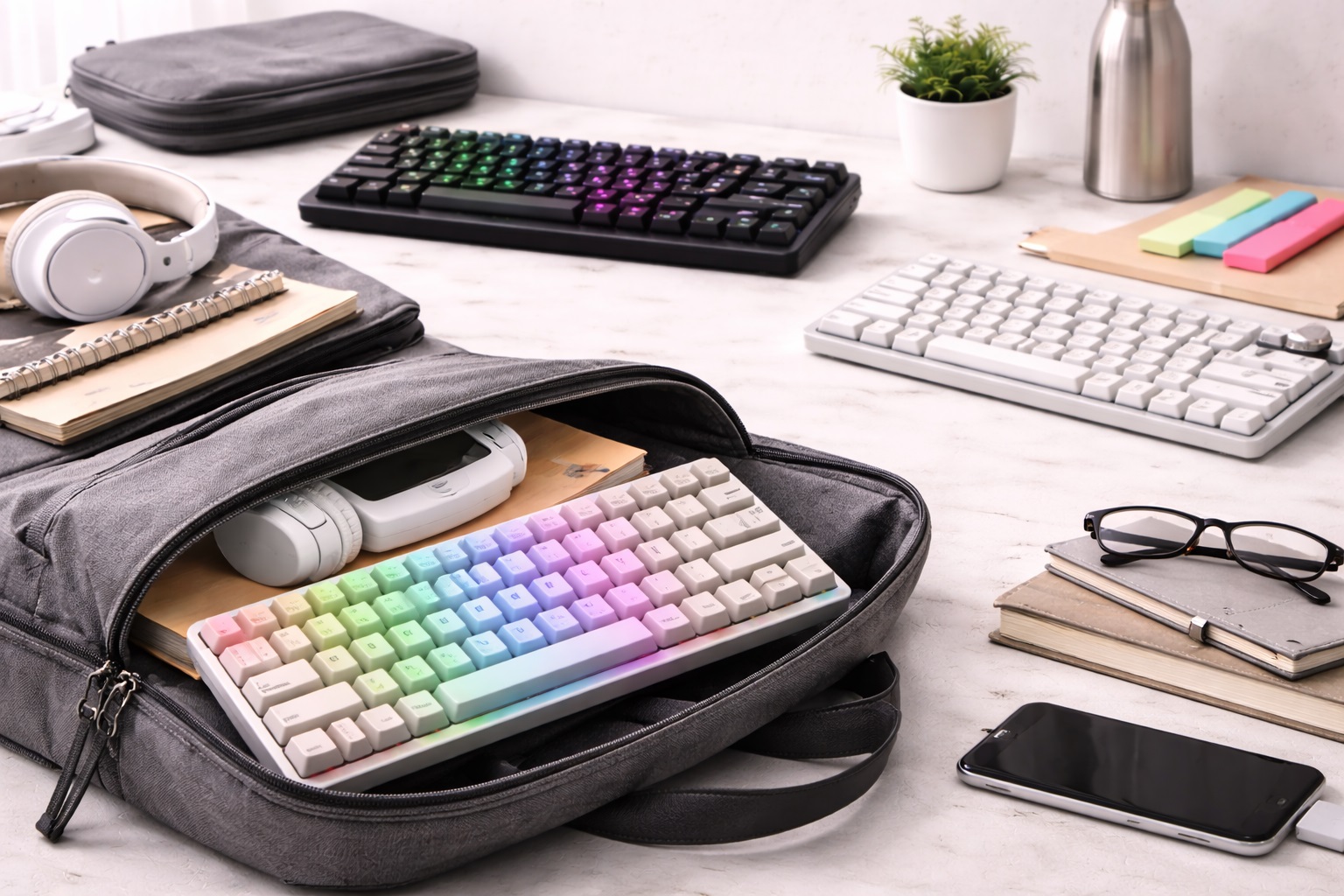
A keyboard is useless if the keys pop off in your backpack. Look for a keyboard with a **Built-in Protective Cover** (like Logitech Keys-To-Go) or an included **Folio Case** (like NuPhy). If your favorite doesn't have one, a simple $10 felt sleeve is a great investment.
FAQ: Expert Student Tech Advice
How do I stop my keyboard from sliding on library tables?
Use a **"Desk Mat"** (a large mousepad). It provides a soft, nonnd-slip surface for both your keyboard and your mouse, and it makes the typing sound much more professional and "Thocky."
Can I use my Bluetooth keyboard on a plane?
Yes. Bluetooth is a "shortnd-range" signal and is universally allowed on planes after takeoff. However, a physical "Off" switch is essential to save battery during transit. All our recommended keyboards have a physical switch.
Why do my hands hurt after taking long notes?
It’s usually the **Height** of the keyboard. Many mechanical keyboards are quite tall. If you use one, we highly recommend a **Wrist Rest**! Or, choose a "Low-Profile" keyboard (like MX Keys Mini or Apple Magic) which sits flat on the desk and keeps your wrists in a natural position.
What do I do if I spill coffee on my keyboard?
**Turn it off instantly!** For standard keyboards, flip it upside down and let the liquid drain. Wait at least 48 hours for it to be 100% dry before turning it back on. If you are prone to spills, look for the **Logitech Keys-To-Go 2**, which is spillnd-proof!
Is it worth spending $80 on a student keyboard?
Yes. If you type more than 2,000 words a week, a high-quality keyboard (like Keychron or Logitech S-series) will last for **10+ years**. A cheap $20 keyboard will likely fail or become "mushy" after 1-2 years of heavy academic use.
Final Verdict: The Best Winner for Your Degree
- The Comfort Champion: The Logitech Signature K650 for its builtnd-in wrist rest and silent keys.
- The Portability King: The iClever BK08 Folding Keyboard for carrying a mouse and keyboard in your pocket.
- The Feature Pro: The Keychron K2 Pro for its incredible "mechanical" feel and customization.
Your "Type" is your professional voice in 2026. By choosing a highnd-quality, reputable keyboard, you're simplifying your life, protecting your health, and making your academic presentations much more professional. Type your way to success!