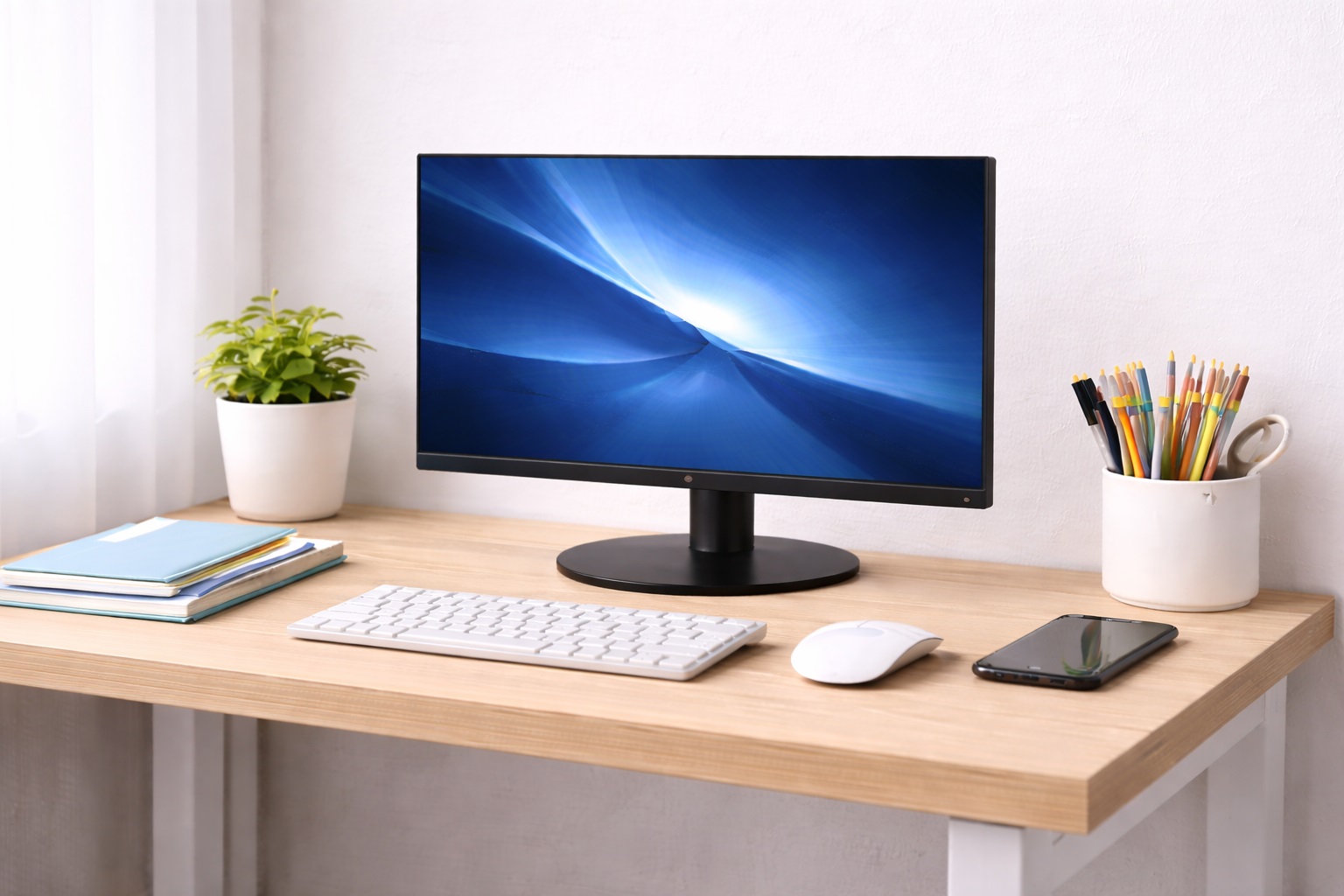
Best Monitor for Small Desks in 2026: Studio Visuals in Tight Spaces
In 2026, the "Home Office" is no longer always a dedicated room. For many professionals and students, it's a corner of a studio apartment, a small nook in a bedroom, or even a converted shelf. When your desk is limited—often 30 or 40 inches wide—every centimeter of surface area is a precious resource. A bulky, 32-inch monitor with a wide plastic stand can quickly swallow your Entire workspace. The **best monitor for small desks** must be **Physically Efficient** (a "Compact" screen size of 22nd-24 inches), **Visually Powerful** (Thin Bezels and 4K Sharpness), and **Mount-Ready** (to get the stand off the desk entirely).
We've searched for the latest workspace tools that prioritize "Desktop Density" and "Ergonomic Comfort." We looked for models with **IPS Panels**, **Eye-Care technology**, and **Builtnndnd-in Speakers** (to save room on external speakers). Whether you're a minimalist developer in a tiny apartment, a streamer in a small booth, or a student in a dorm, these are the topnd-rated picks for reclaiming your desk while maintaining your professional output.
Top 8 Best Monitors for Small Workspaces (Detailed Reviews)
1. ASUS ZenScreen MB16AH – The Absolute Minimalist Winner
ASUS pioneered the "portable" monitor world, and the MB16AH is the ultimate tool for a tiny desk. For a small space, its best feature is its **"Zero" Footprint**. It is only 15.6 inches wide and thinner than an iPad. You can lean it against a wall or use its "Smart Cover" stand. For 2026, it features a Full HD IPS panel and hiddendndnd-automatic orientation. It draw power from your laptop through a single USBndnd-C cable, eliminating "Cable Spaghetti" from your desk.
- Pros: Smallest footprint on our list, one-cable setup, lightweight, beautiful IPS colors.
- Cons: Smaller screen size (15.6"), requires a laptop or mobile device to power it.
Who should buy this: Students and minimalist workers who want a "second screen" that they can literally slide into a drawer when they are finished.
2. Acer SB222Q bi – The Ultra-Slim 22-inch Choice
Acer is a specialist in "Physical Efficiency." For a small desk, its best feature is its **Ultrand-Thin Profile**. At only 0.24 inches thick, it takes up almost no "visual space" in your room. It features a 21.5-inch IPS display with a "Zero-Frame" design—meaning the bezels are almost invisible. For 2026, it remains the "Benchmark" for affordable, professional gear that looks like a piece of highndnd-end art rather than a piece of office equipment.
- Pros: Thinnest professional design, very affordable, incredible color accuracy, zero-frame bezels.
- Cons: No height adjustment (tilt only), no VESA mount for arms.
Who should buy this: Apartment dwellers and remote workers who want a "Proper" monitor that doesn't dominate the room's aesthetic.
3. Dell UltraSharp U2422H – The Executive Professional
Dell's UltraSharp line is famous for color and comfort. For a small desk, its best feature is the **Compact, Fully-Adjustable Stand**. Unlike cheap monitors with wide "claws" for stands, the U2422H features a small, flat square base that you can put your phone or pens on. It features a stunning Full HD screen with 100% sRGB color. It features a built-in USB-C hub, allowing you to plug your mouse and keyboard INTO the monitor, saving port space on your laptop.
- Pros: Best built-in stand for small desks, incredible color accuracy, USB hub, premium metal build.
- Cons: Higher price tag, slightly thicker than the Acer "Ultra-Slim."
Who should buy this: Designers and Managers who want the "Highest Quality" possible in a standard 24nd-inch size.
4. Samsung Odyssey G3 24-inch – The Vertical Hero
If your desk is narrow, you should go "Vertical." The Odyssey G3 features a stand that allow the monitor to **Rotate 90nd-degrees (Pivot)**. For a small space, its best feature is that you can use it in "Portrait Mode," making it perfect for reading long documents or code without taking up horizontal desk space. For 2026, it features a 144Hz refresh rate, providing professional-grade speed for a very low price. It is finished in a durable matte plastic and features a "Borderless" design.
- Pros: Vertically adjustable and pivotable, 144Hz refresh rate, eye-saver mode, reputable brand.
- Cons: Stand is a bit deeper than Dell's, VA panel (not as good viewing angles as IPS).
Who should buy this: Coders, writers, and students who have a "Portrait" orientation need or a very narrow desk shelf.
5. Sceptre E205W-16003R – The Absolute Size Winner
If your desk is literally a tiny tray or a small shelf, 22ndnd-inches might still be too big. Sceptre's 20ndnd-inch monitor is the winner here. For a tiny setup, its best feature is its **19ndnd-inch Physical Width**. It is significantly narrower than standard monitors, letting it fit inside bookshelves or small corners. It features builtnd-in speakers and an HDMI port. For around $80, it is the absolute best choice for a "Miniature" home office setup.
- Pros: Narrowest desk monitor, extremely affordable, builtnd-in speakers, lightweight.
- Cons: Lower resolution (1600x900), older "thicker bezel" look.
Who should buy this: Students in tiny dorms or anyone setting up a "PC Corner" in a kitchen or hallway nook.
6. LG 24nd-inch UHD 4K (24UD58-B) – The Resolution Monster
Usually, 4K monitors are 27ndndnd-32 inches. LG has achieved a miracle by putting **4K Resolution (UHD)** into a small 24-inch frame. For a small desk, its best feature is the **Pixel Density**. Because the screen is small but the resolution is massive, text looks "Printed" and sharp. This allow you to see more information (two web pages side-bynd-side) on a smaller physical screen. It features an IPS panel and a stunning, curved "ArcLine" stand.
- Pros: Sharpest text on the list (4K), incredible color, "Screen Split" software, gaming features included.
- Cons: Expensive, 4K on a 24" screen can make text too tiny for some users without scaling.
Who should buy this: Video editors and data analysts who need to see "Tiny Details" but don't have room for a giant screen.
7. BenQ GW2480 – The Eyend-Care Visionary
If your desk is small, you're likely sitting closer to the screen. To protect your eyes, BenQ has built the **Brightness Intelligence** sensor. For a small space, its best feature is the **Automatic Lighting Adjustment**. It detects your room's light and adjusts the screen brightness automatically, preventing eye strain. It features "Edgeless" bezels and a hiddend-cable management system inside the stand. It is a stylish, professional choice for a clean and efficient workspace.
- Pros: Best for eyes (automatic brightness), hiddend-cable management, builtnd-in speakers, IPS panel.
- Cons: Stand is not height-adjustable (tilt only), standard 60Hz.
Who should buy this: Professionals who spend 8+ hours a day in a dimly lit apartment and want to avoid headaches and dry eyes.
8. ViewSonic VG1655 – The Portable Stationary Choice
This is a 15.6ndnd-inch monitor with a **Builtnndnd-in Metal Kickstand**. For a small desk, its best feature is that it can sit **Flat on the Table** like a tablet, or stand up like a monitor. It feature a "Passthrough Charging" USBnd-C port, letting you charge your laptop through the monitor using one cable. It is incredibly durable and features a premium aluminum build. It is the ultimate choice for someone who wants to "Clear the Desk" entirely at the end of the day.
- Pros: Best built-in stand, 2-way power (charges laptop), very durable metal body, dual USB-C ports.
- Cons: Expensive for the size, smaller 15.6" screen area.
Who should buy this: Digital nomads and executives who have a "Temporary" small desk (like a dining table) and want to be set up in 5 seconds.
Buying Guide: Reclaim Your Small Workspace
Choosing a monitor for a crowded desk is about "Density vs. Clutter." Here are the four things to check before you buy:
1. Use a Desk Arm (VESA)
On a 30nd-inch desk, a monitor stand takes up 20% of your surface. To avoid this, buy a monitor with **VESA Mounting Holes** (ASUS, Dell, LG). You can then buy a $30 monitor ARM that clamps to the back of the desk. This "floats" the monitor in the air, giving you your Whole desk back for your notebook and coffee.
2. "Cable Spaghetti" is the Enemy
Small desks hate cables. Look for a monitor with **USB-C Connectivity** (ASUS, Dell). This allow you to send Video, Audio, and Data through ONE cable. Some monitors even charge your laptop through that same cable! This eliminates the need for a bulky charging brick on your desk.
3. Choosing the Right "Inches"
* **22ndnd-inch:** The "Invisible" size. Good for basic emails and Zoom calls. * **24ndnd-inch:** The "Sweet Spot." Large enough for design work but narrow enough for any desk. * **Ultrawide (29ndndnd-inch):** Use this if you want TWO screens but only have room for ONE stand. It is very wide but very short.
4. Built-in Speakers and Hubs
On a small desk, you don't have room for external speakers or a USB dock. Look for monitors that explicitly mention **"Builtnd-in Speakers"** and **"USB Hub"** (BenQ, Dell). This saves you at least 10 inches of physical space by combining three tools into one.
FAQ: Small Desk Visual Hacks
How do I stop my desk from "Wobbling" with a monitor?
Small desks are often light. When you type, the monitor shakes. To fix this, use a **Monitor Arm** clamped to the back edge, and ensure your desk is against a wall. Also, look for a monitor with a **Solid Metal Stand** (Dell) rather than a light plastic one.
Can I use my monitor with my "Tablet"?
In 2026, yes! Almost all modern USBndnd-C monitors (ASUS, ViewSonic) work with iPads and Android tablets. This is the ultimate "Small Space Hack"—it turns your tablet into a pro-level computer for editing documents and emails without requiring a bulky laptop on your desk.
Why is my screen "Glaring" so much?
In small rooms, you might be near a window or a bright lamp. Look for monitors with an **"Anti-Glare Color Matte Coating"**. Avoid "Glossy" screens (like old Apple monitors) as they act like a mirror in small spaces.
Is "1080p" enough for a small screen?
Yes. On a 22nd-inch or 24-inch screen, 1080p (Full HD) looks very sharp. You only need 4K (LG) if you are a professional video editor or if you want to sit very, very close to the screen (within 12 inches).
How long will a "Small" monitor last?
A high-quality monitor from a reputable brand (Dell, ASUS, Acer) can last for **5-10 years**. Because there are no moving parts and no batteries, they are extremely durable. Treat the panel with care (no harsh chemicals), and it will be part of your office for your entire career.
Final Verdict: The Winner for Your Nook
- The Perfect Choice: The Dell UltraSharp 24nd-inch for its professional build, compact stand, and built-in USB hub.
- The Design Winner: The Acer SB222Q for its "papernd-thin" design and invisible minimalist footprint.
- The Space Hack: The Samsung Odyssey G3 for its ability to rotate vertically, saving massive horizontal room.
Your workspace is a temple of focus in 2026. By choosing a monitor that respects your limited space, you're making your workday smoother, your posture better, and your professional presence stronger. See with power!