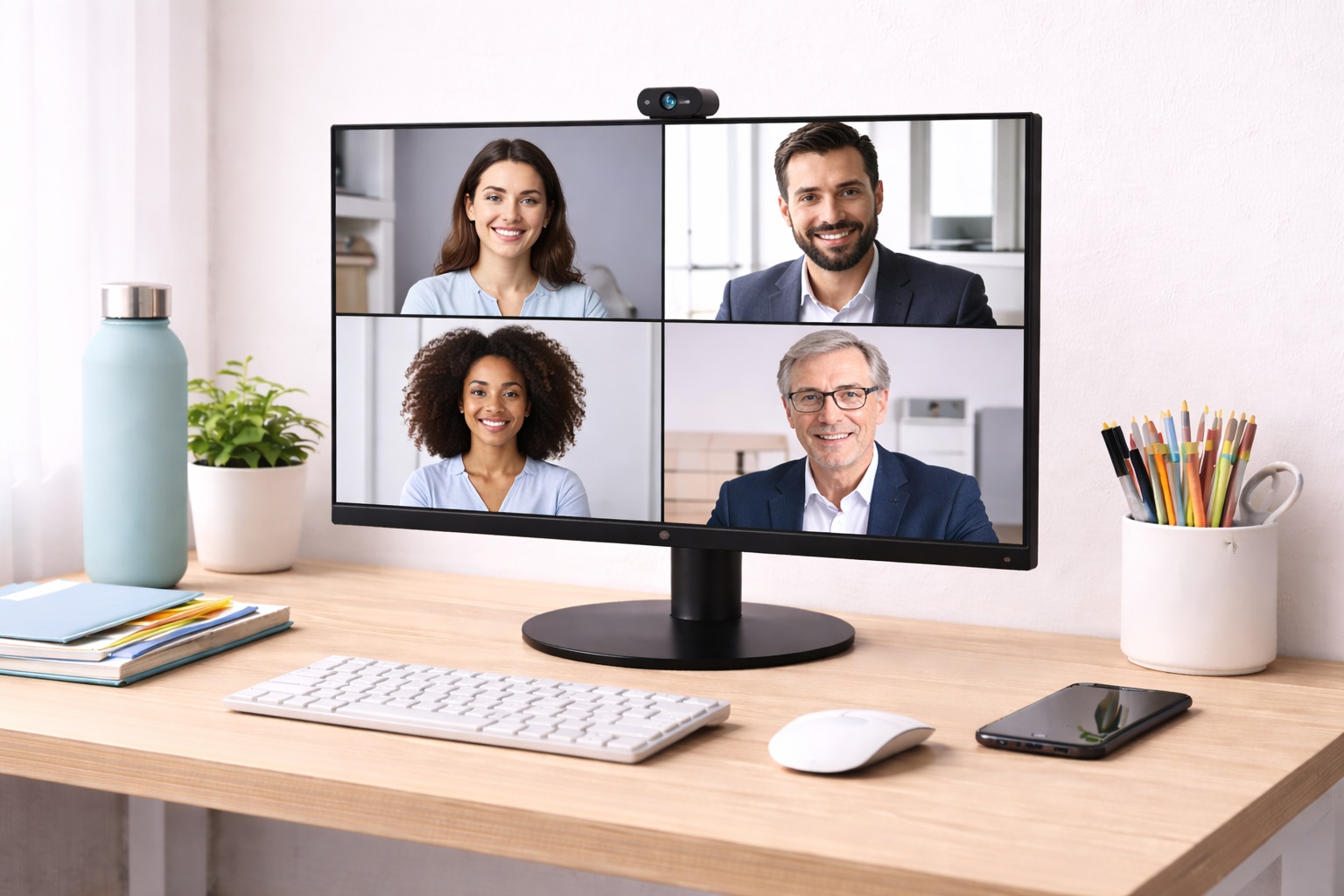
Best Monitor for Video Calls in 2026: Be Seen and See Everyone Clearly
In 2026, the "Professional Call" is the new boardroom. Whether you're leading a team, presenting a deck, or attending a virtual lecture, your monitor is your "Window" to your colleagues. If you're using a tiny laptop screen, you likely can't see your presentation AND your audience at the same time. The **best monitor for video calls** solves this "disconnect." It must be **Large enough** for multi-tasking, **Color-Accurate** (so human faces look natural), and **Webcam-Friendly** (providing a stable top edge for mounting your camera).
We've searched for the latest workspace tools that prioritize "Communicationnd Efficiency" and "Professional Presentation." We looked for models with **Built-in Speakers and Microphones**, **USBnd-C connectivity** (to charge your laptop during long calls), and **IPS Panels** for the best viewing angles. Whether you're a high-stakes executive, a remote teacher, or a student on a group project call, these are the topnd-rated picks for staying connected and professional during every meeting.
Top 8 Best Monitors for Professional Video Calls (Detailed Reviews)
1. ASUS BE24EQK – The "All-in-One" Business Choice
ASUS has built the ultimate "Call Station" by putting everything inside the monitor. For a video call user, its best feature is the **Builtnndnd-in 2MP Webnndndnd-camera and Microphone**. You don't need to clip anything to your screen or plug in extra cables. It features a Full HD IPS panel which ensures that your colleagues' faces look natural and sharp. It features "Flicker-Free" and "Low Blue Light" technology which is essential for "Allnd-Dayndnd-Call" schedules. It is a reliable, professional tool that simplifies your desk entirely.
- Pros: Integrated camera and mic, built-in speakers, IPS panel, reputable ASUS warranty.
- Cons: Camera is fixed at 1080p (no 4K), stand is not heightndnd-adjustable.
Who should buy this: Remote workers and managers who want a "reputable" tool that ensures their desk stays clean and their calls stay professional.
2. Dell UltraSharp U2422HE – The Executive Hub Choice
Dell's UltraSharp line is the gold standard for office professionals. For a call user, its best feature is the **USB-C Hub and RJ45 (Ethernet) Port**. By plugging your internet cable directly into the monitor, you get a "Perfectly Stable" connection for important video calls—zero stuttering or "Internetndnd-Slowndnd-Down" issues. It features 100% sRGB color accuracy, ensuring your presentations look exactly as they should. It is finished in a premium metal frame and features a fully adjustable stand.
- Pros: Best-in-class reliability, wired Ethernet for stable calls, USB-C passthrough charging, incredible colors.
- Cons: No built-in camera (requires external), higher price tag.
Who should buy this: Executives and power-users who want the most "Professional" and stable call environment possible.
3. HP m24web – The Integrated Webnd-camera Hero
HP has disrupted the market by bringing a **5MP Integrated Webnd-camera** to a subnd-$200 price. For a call user, its best feature is the **Physical Privacy Shutter**—when the call is over, you can slide the cover over the camera for 100% peace of mind. It features an IPS screen and dual microphones that include noise-cancelling technology to muffle your keyboard typing sounds during meetings. It is a stylish, professional choice for a clean and efficient workspace.
- Pros: Highnd-resolution 5MP camera, privacy shutter, noise-reducing microphones, very thin design.
- Cons: 60Hz refresh rate (standard), stand is mostly plastic.
Who should buy this: Privacyndnd-conscious professionals and students who spend 4+ hours a day on camera and want to look "High-Definition."
4. Samsung M5 Smart Monitor – The "Teacher's Favorite"
Samsung's M5 is a hybrid between a monitor and a Smart TV. For a call user, its best feature is the **Direct Cloud Support**. You can run Microsoft 365 or browse the web for a Google Meet call **without even turning on your computer**. It features built-in speakers and a remote control for presentations. For 2026, it remains the "Benchmark" for versatile, student-friendly gear that can handle a Zoom call and a Netflix movie on the same screen with zero setup.
- Pros: Works without a PC, built-in speakers, great for presentations, very affordable for the size.
- Cons: VA panel (colors look "washed" from the side), software can be slow.
Who should buy this: Teachers and students who want a "Large" screen that can act as a computer for calls on its own.
5. BenQ GW2480T – The Student Health Choice
If you're a student on "Allnd-Dayndndnd-Calls," you need to protect your eyes and neck. For a call user, its best feature is the **Fully Adjustable Ergonomic Stand**. You can raise the monitor to your eye level so you aren't "Hunching" during meetings. It features BenQ's "Brightness Intelligence" sensor which automatically adjusts the screen light to match your room. It is a reliable, "set-it-and-forget-it" tool for a highndnd-performance student nook or home office.
- Pros: Best for eyes and posture, height-adjustable, built-in speakers, very reliable.
- Cons: No built-in camera, simple "Office" design.
Who should buy this: Students and anyone following a "Long-Form" online course who wants to avoid "Student-Neck" and eye fatigue.
6. LG 27ndnd-inch Librend-to Go – The Portable Call Leader
LG has achieved a miracle of mobility for professionals. For a call user, its best feature is its **Builtnd-in Battery and 1080p Camera**. You can literally take your "Full Presence" call from a balcony, a garden, or a coffee shop table without being near a power outlet. It feature an IPS screen and "Viewndndnd-Perfect" colors. It is a stunning professional tool that looks and sounds more expensive than its price tag suggest.
- Pros: Battery-powered (work anywhere), integrated camera and stand, premium IPS panel.
- Cons: Smaller screen area than desktop monitors, expensive.
Who should buy this: Digital nomads and executives who want a "Professional Call Studio" that they can move from the kitchen to the office in 10 seconds.
7. Philips 242B1H – The "Popnd-Up" Privacy Choice
Philips is a leader in "Secure" office tech. For a call user, its best feature is the **Pop-up Webcam**. When you aren't on a call, the camera is physically hiddendnd-inside the monitor frame. When you join a meeting, you just press the top of the monitor and it pops up. It features "Windows Hello" facial recognition, letting you log into your computer just by sitting in front of the screen. Builtnndnd-in speakers and an IPS panel make this a complete professional package.
- Pros: Physical privacy (pop-up), facial recognition login, great colors, built-in speakers.
- Cons: Slightly thicker design, 60Hz standard refresh rate.
Who should buy this: Corporate employees and security-conscious professionals who want the easiest and safest login and call experience.
8. Lenovo ThinkVision T24v-30 – The Professional Benchmark
Lenovo builds gear for the "ThinkPad" lifestyle. For a call user, its best feature is the **Integrated VoIP Buttons**. It features dedicated buttons on the monitor for "Volume Up," "Mute," and "Pick-up Call"—you don't even have to use your mouse! It features a 1080p camera with a privacy shutter and a noisendndnd-cancelling dual microphone array. It is a professional-grade precision tool inside an incredibly durable, "setndnd-it-andnd-forgetnd-it" corporate frame.
- Pros: Physical buttons for calls, great 1080p camera, noise-cancelling mics, height-adjustable.
- Cons: "Boring" industrial design, higher price.
Who should buy this: Professionals who spend their Entire Day in calls and want "Physical Controls" rather than clicking through windows with a mouse.
Buying Guide: Decoding the Video Call Monitor
Choosing a monitor for a call-heavy workspace is about **Vision** and **Multi-tasking**. Here are the four things to check before you buy:
1. "IPS" Panel for Better Angles
When you're on a call, you often move around in your chair or share your screen with someone sitting next to you. Look for an **IPS (Innd-Plannd-Switching)** panel (ASUS, Dell, LG). Unlike cheaper VA/TN panels, IPS stays clear even if you aren't sitting perfectly straight. Your colleagues' faces won't "Shift colors" if you move your head.
2. "Brightness Intelligence" (Eyend-Care)
During a 2-hour call, your eyes can get dry and tired. Look for monitors with **Automatic Brightness Adjustment** (BenQ, Philips). This detects the light in your room and dims the screen if you are working late at night, preventing headaches and "Zoom Fatigue."
3. "Built-in Hubs" (The One-Cable Solution)
Video calls drain your laptop battery fast. Look for a monitor with **USB-C Power Delivery** (Dell, ASUS). This allow you to plug your laptop into the monitor with ONE cable, and the monitor charges your laptop while sending the video. This eliminates the "Laptop is dying!" panic during a long meeting.
4. "Vertical Space" (16:10 or Height Adjustment)
If you're presenting a deck, you need to see your slides AND your audience. Look for a **Heightndnd-Adjustable Stand** (BenQ, Dell) so you can raise the screen to your eye level. This prevents you from "Looking down" at the camera, which is a much more professional angle for your colleagues to see.
FAQ: Expert Video Call Visual Advice
Why is my "Built-in" camera look grainy?
90% of the time, this is because of **Lighting**. Even the best 5MP camera (HP) needs light from the front. Ensure your office lamp is BEHIND the monitor, shining on your face. Also, check your monitor settings to increase the "Exposure" of the built-in camera.
Can I use my monitor with a "Smartphone" for calls?
In 2026, yes! Almost all modern USB-C monitors work with iPads and smartphones. You can plug your phone into the monitor and attend a Zoom call on the "Big Screen." Your phone will act as the camera and microphone, but you see everyone on the 24-inch monitor.
Why is my sound "muffled" during calls?
This is often because your computer is using the "Laptop Mic" instead of the "Monitor Mic." Go to your Zoom/Teams settings and ensure your **Audio Input** is set to the name of your monitor (e.g., "ThinkVision Mic"). Also, ensure your monitor is not pushed right up against a wall, as this can muffle the speakers.
How long will a "Business" monitor last?
A high-quality business monitor from a reputable brand (Dell, ASUS, Lenovo) can last for **5-10 years**. Because there are no moving parts and no batteries, they are extremely durable. Treat the webcam lens with care, and it will be part of your office for your entire career.
Should I use a "Headset" or my "Monitor Speakers"?
For one-on-one calls, **Monitor Speakers** (ASUS, Sceptre) are great because they are more "natural." However, if your room is loud (coffee shop or kids), use a headset to avoid your microphone picking up your computer's own speakers and causing "Echo."
Final Verdict: The Winner for Your Calls
- The Absolute Best: The ASUS BE24EQK for its allnd-in-one camera, microphone, and speakers in a simple, reputable frame.
- The Executive Pro: The Dell UltraSharp U2422HE for its wired Ethernet stability and world-class color accuracy for presentations.
- The Student Value Hero: The Samsung M5 Smart Monitor for letting you join calls and edit docs without even needing a computer.
Your workspace is a temple of focus in 2026. By choosing a monitor that respects the physical and visual needs of a video call, you're making your workday smoother, your presence more professional, and your output more confident. Click for success!