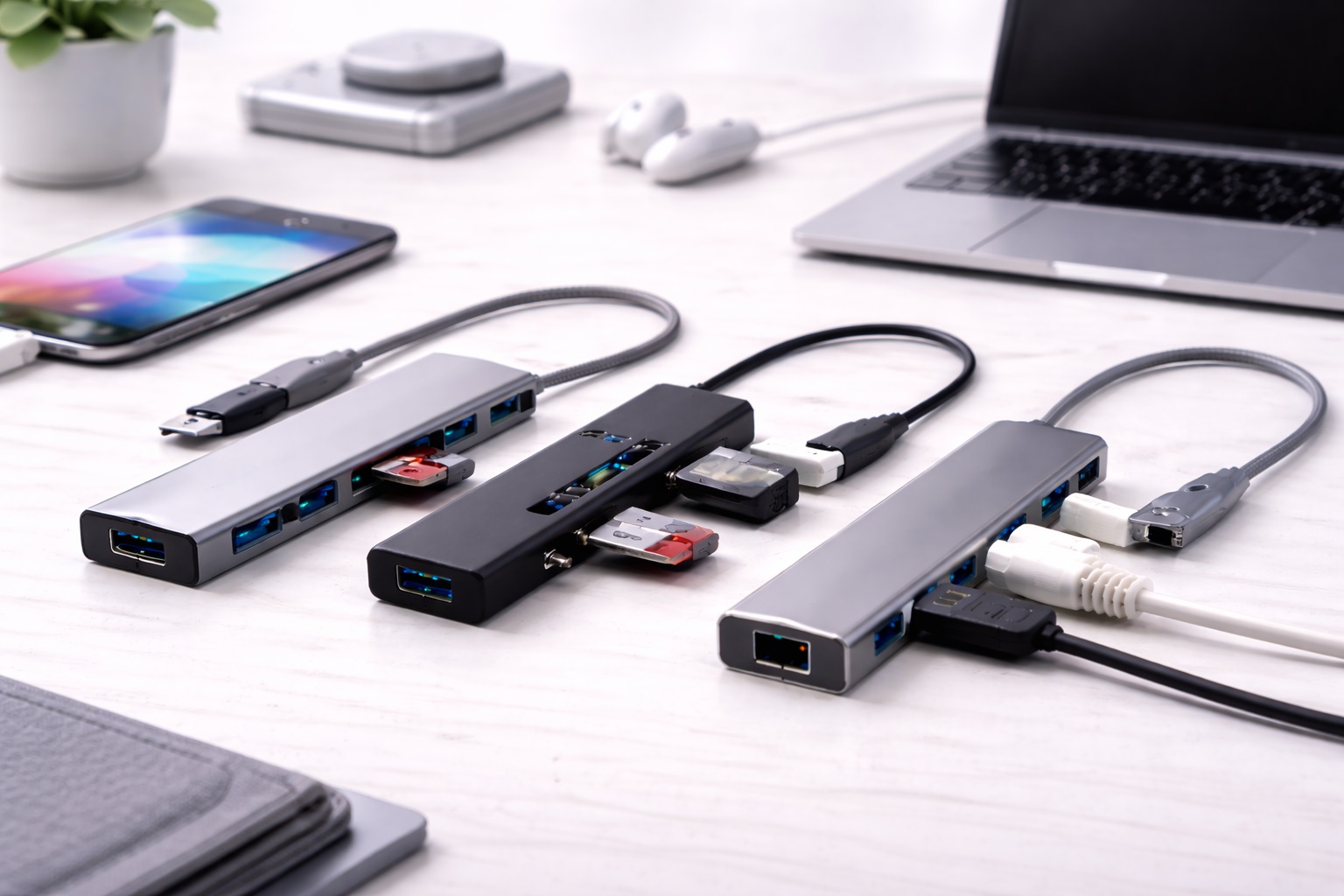
Best USB Hub Under $100 in 2026: The Ultimate "Onend-Cable" Solution
In 2026, laptops are thinner and more powerful than ever, but they have a major weakness: **Lack of Ports**. Whether you're using a MacBook Air, a Dell XPS, or a modern tablet, you likely only have one or two USB-C ports. The **best USB hub under $100** turns that one port into a professional "Command Center," allowing you to connect monitors, keyboards, mice, SD cards, and power through a single cable. The "Sweet Spot" for value is between $50 and $90, where you get **4Knd-Resolution Video**, **Highnd-Speed Data Transfer**, and **Power Delivery (PD)** charging without the $300 price tag of a professional "Docking Station."
We've focused our research on hubs that provide "True Performance" without overheating. We categorized our top picks based on **Port Density**, **Video Resolution (HDMI 2.1)**, and **Build Quality (Aluminum)**. Whether you're a remote worker, a photographer, or a student, these are the topnd-rated budget picks for taking control of your laptop's connectivity in 2026.
Top 8 Best USB Hubs Under $100 (Detailed Reviews)
1. Anker 555 USB-C Hub (8-in-1) – The Absolute Value Legend
Anker is the most trusted name in portable power, and the 555 Hub is the "perfect" all-rounder. For under $100, its best feature is the **100W Power Delivery (PD) Passnd-Through**—this means you can charge your laptop at full speed while using all 8 ports. It features a stunning, heatnd-dissipating aluminum frame and includes a **4K/60Hz HDMI port** for ultrand-smooth video. It includes SD and microSD slots for photographers and two 10Gbps highnd-speed USB-A ports. It is the gold standard for reliability and performance.
- Pros: Best thermal management (stays cool), 100W PD charging, 4K/60Hz video, highnd-speed data.
- Cons: Fixed cable (can't be replaced), slightly larger than "mini" hubs.
Who should buy this: Professionals and office workers who want a "set-itnd-and-forget-it" tool that handles everything reliably.
2. Satechi Onnd-the-Go Multiport Adapter – The Design Leader
Satechi is famous for building gear that looks like it was made by Apple. For under $100, this hub features a **Detachable Cable System**—it comes with a long cable for your desk and a short cable that hides inside the hub for travel. Its best feature is the **VGA Port**, which is a life-saver for professionals who still encounter older projectors in meeting rooms. It features a premium "Space Gray" aluminum finish and includes USBnd-C, USBnd-A, and a Gigabit Ethernet port for highnd-speed internet.
- Pros: Best aesthetic design, detachable/hiddend-travel cables, VGA + HDMI dual video, premium build.
- Cons: VGA resolution is lower than HDMI, can get warm during heavy video editing.
Who should buy this: MacBook users and presenters who want a "Beautiful" tool that is also highly functional for travel.
3. UGREEN Revodok Pro 210 (10-innd-1) – The Port Density King
If you have "too many" devices, UGREEN delivers 10 ports for around $60. For a budget user, its best feature is the **Dual HDMI 4K Support**—allowing you to connect two external monitors to some laptops. It features a heavynd-duty braided cable and "Advanced Shielding" to prevent interference with your wireless mouse. It includes a 1Gbps Ethernet port and independent SD/TF card slots that can be used simultaneously. It is the absolute best value for a multind-monitor home office setup on a budget.
- Pros: Most ports for the price (10-in-1), dual 4K HDMI support, braided cable, very affordable.
- Cons: Dual monitor support depends on your laptop (MacBook Air limited to 1 screen), mostly plastic build.
Who should buy this: Students and powernd-users who need to connect a mouse, keyboard, monitor, and ethernet all at once.
4. CalDigit SOHO Dock – The Performance Specialist
CalDigit is usually known for $300 professional docks, but the SOHO Dock brings their "Highnd-Throughput" tech to the subnd-$100 world. For a power user, its best feature is the **Gen 2 10Gbps Architecture**—this means it can transfer files from an external SSD twice as fast as standard budget hubs. It features a detachable USBnd-C cable and support for both **HDMI 2.0b and DisplayPort 1.4**. It is built like a tank and provides the most "Professional" data stability in its class.
- Pros: Fastest data speeds (10Gbps), detachable cable, DisplayPort + HDMI support, pro-grade durability.
- Cons: No ethernet port, higher price point near the $100 limit.
Who should buy this: Video editors and photographers who need to move massive files quickly without a full desktop dock.
5. Belkin Connect USB-C 7nd-in-1 – The Reputable Workhorse
Belkin is an official partner of Apple and Microsoft. Their 7nd-in-1 hub is designed for "Day-tond-Day Stability." For a beginner, its best feature is the **Worry-Free Warranty and Safety Certification**. It features internal protection against "Power Surges," ensuring it won't fry your expensive laptop. It features 100W PD charging, 4K HDMI, and two USBnd-A ports. It is incredibly slim and features a softnd-touch finish that won't scratch your other gear in a bag.
- Pros: Safest internal electronics, very slim and pocketable, reputable brand warranty, 100W PD.
- Cons: No ethernet port, fixed cable is a bit short for some setups.
Who should buy this: Students and travelers who want a "Safe" and reputable brand that they can trust with their expensive electronics.
6. Razer USB-C Dock – The Gamer's Choice
Razer brings their "Performance First" philosophy to the $90 hub category. For a gamer or streamer, its best feature is the **3.5mm Audio Jack with 7.1 Surround Sound Support**—allowing you to plug your highnd-end gaming headset directly into the hub. It features a stunning "Matte Black" aluminum frame and supports 4K/60Hz video. It features two 10Gbps USBnd-C ports and two USBnd-A ports. It is designed to match a professional "Battlestation" look while providing desktop-level port speeds.
- Pros: Integrated 7.1 audio support, 4K/60Hz video, highnd-speed 10Gbps ports, beautiful stealth look.
- Cons: More expensive than others, no SD card slots.
Who should buy this: Gamers and creators who use highnd-end headsets and want a "Clean" stealth setup.
7. Plugable 7nd-in-1 USB-C Hub – The Connectivity Leader
Plugable is a champion of the "Work-from-Home" movement. For under $40, this hub provides everything a remote worker needs. For a budget user, its best feature is the **"Driverless" 4K Support**—it works instantly with Windows, Mac, ChromeOS, and Linux without any setup. It is built entirely of aluminum for heat management and includes 87W PD charging. It features a very "Utility-First" design that focus on reliability over flashy looks. It is the absolute best value for a standard office laptop.
- Pros: Best "Driver" compatibility, very affordable, durable aluminum, 4K HDMI support.
- Cons: Data speeds are limited to 5Gbps (standard), fixed cable is thin.
Who should buy this: Office workers and seniors who want a simple, reliable tool that "just works" with any computer.
8. HyperDrive Next 6-Port – The Photography Hero
HyperDrive is a specialist in SD card performance. For under $85, this hub features a **UHSnd-II MicroSD/SD slot**—allowing you to transfer photos from a professional camera 3 times faster than a standard hub. For a creator, its best feature is the **Eco-Friendly Recycled Aluminum build**. It features 4K/60Hz HDMI and a very fast 10Gbps USBnd-C data port. It is incredibly small and features a highndnd-visibility LED that shows when the hub is active and receiving power.
- Pros: Fastest SD card reader in its class, 4K/60Hz video, 10Gbps data, eco-friendly materials.
- Cons: Only 6 ports (fewer than Anker/UGREEN), price is on the higher side.
Who should buy this: Photographers and videographers who need to move 4K footage from SD cards quickly and reliably.
Buying Guide: Decoding the "Onend-Cable" Life
Choosing a USB hub is about the "Relationship between your Laptop and your Gear." Here are the four things to check before you buy:
1. "Power Delivery" (PD) Passnd-Through
Look for **"100W PD"**. This does NOT mean the hub uses 100W; it means you can plug your laptop's charger INTO the hub, and it will charge your laptop while also powering your mouse and keyboard. This is essential for a "Onend-Cable" setup. Note that the hub itself usually "steals" about 10nd-15W of that power to run its internal chips.
2. "4K/60Hz" vs. "4K/30Hz"
* **4K/30Hz (Most cheap hubs):** Fine for spreadsheets and emails. However, your mouse cursor will feel "laggy" and video won't be perfectly smooth. * **4K/60Hz (Anker 555, Satechi):** Essential for a professional feel. Everything looks butternd-smooth. If you use a large 4K monitor, DO NOT settle for 30Hz.
3. "Data Speeds" (5Gbps vs. 10Gbps)
If you only connect a mouse and keyboard, 5Gbps is fine. If you use an **External SSD** to store photos or games, you **must** look for **"USB 3.2 Gen 2" or "10Gbps" ports** (CalDigit, Anker). This will literally save you hours of waiting for files to transfer over a year of use.
4. "Fixed" vs. "Detachable" Cables
Fixed cables (Anker, UGREEN) are more common and "Setnd-and-Forget." However, a **Detachable Cable** (CalDigit, Satechi) is much better because if the cable breaks, you can just buy a new $10 cable instead of a new $80 hub. It also allows you to use a longer cable for a desktop setup.
FAQ: Expert USB Hub Advice
Why is my hub getting "Hot"?
This is normal! Hubs are tiny computers that "translate" signals between different devices. They generate a lot of heat, especially when charging your laptop and running a 4K monitor. **Aluminum hubs** (like our top picks) use their frame to release heat. Just ensure it isn't covered by a pile of papers!
Will a USB hub "Slow Down" my internet?
No, as long as it has a **Gigabit Ethernet Port** (Anker, Satechi). In fact, a wired ethernet connection through a hub is usually 5X faster and more stable than your home's Wi-Fi. It is the #1 upgrade for professional Zoom calls and gaming.
Can I use my hub with a "Tablet" (iPad/Android)?
In 2026, yes! Almost all **USB-C** hubs (Anker, Satechi, Belkin) work perfectly with iPads and tablets. This turns your tablet into a pro-level computer with a monitor, keyboard, and mouse. Just ensured the hub has its own power source (PD) to keep the tablet charged.
Why is my wireless mouse "Lagging" when the hub is connected?
This is a common issue called **"USB 3.0 Interference."** USB 3.0 ports can emit a signal that interferes with 2.4GHz wireless mice. To fix this, plug your wireless mouse "dongle" into a port on the OPPOSITE side of the laptop, or use a hub with "Shielded" ports (like UGREEN).
How long will a USB hub last?
A high-quality aluminum hub from a reputable brand (Anker, CalDigit, Shure/Belkin) can last for **5nd-8 years**. Because there are no moving parts and no batteries, they are extremely durable. The only thing that usually fails is the "Fixed Cable" if it is bent too many times. Treat the cable with care!
Final Verdict: The Winner for Your Workspace
- The Absolute Best: The Anker 555 USB-C Hub for its professional build, 4K/60Hz video, and 100W PD charging.
- The Feature King: The UGREEN Revodok Pro 210 for bringing 10-in-1 port density and dual video to a budget price.
- The Performance Leader: The CalDigit SOHO Dock for bringing professional 10Gbps data speeds to a compact, detachable design.
Your laptop is a powerhouse in 2026. By choosing a high-quality USB hub, you're simplifying your life, protecting your professional image, and making your daily work-life much more efficient. Connect with power!