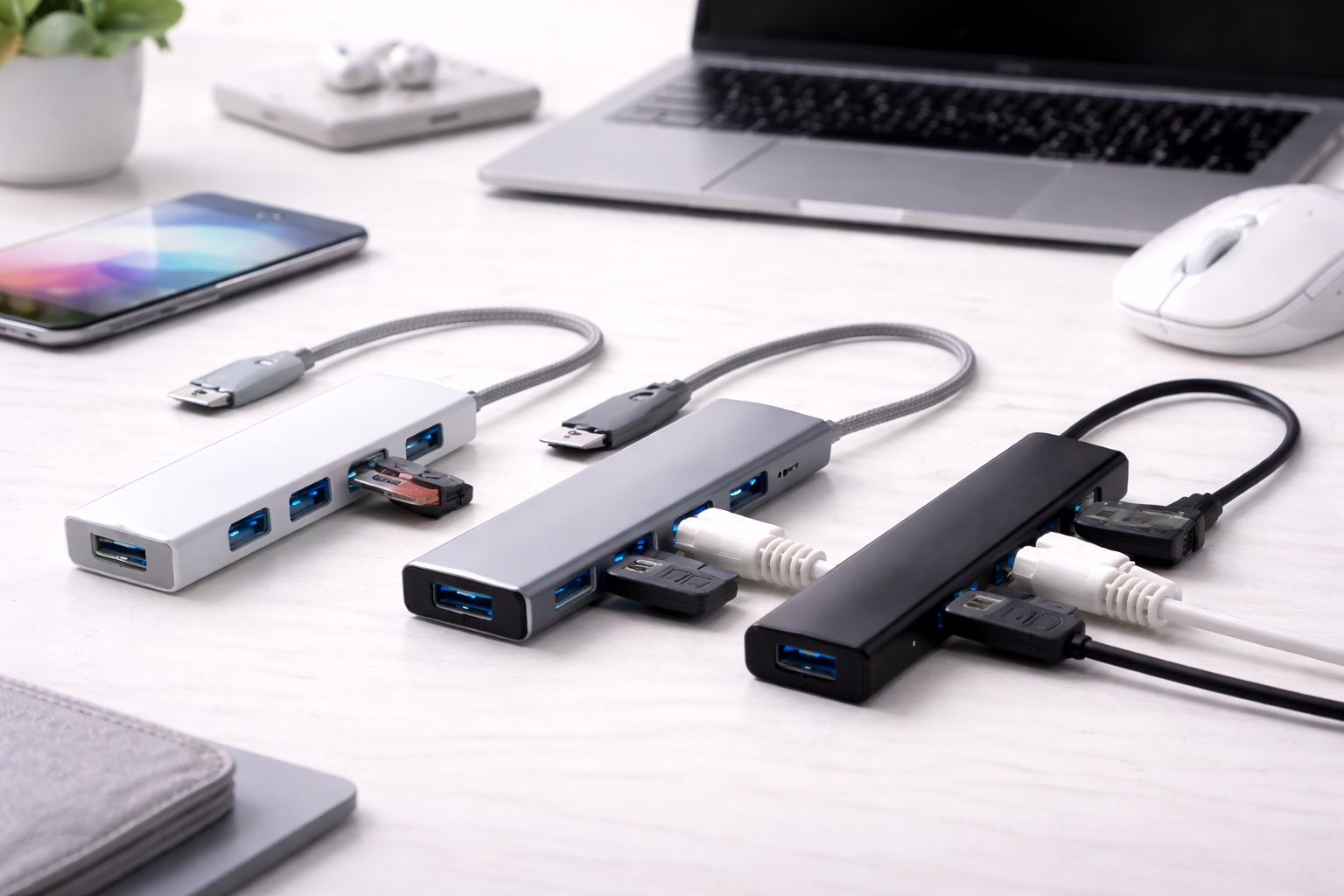
Best USB Hub for Beginners in 2026: The Easiest Way to Perfect Connectivity
If you've recently upgraded your laptop or home office, you've probably noticed that modern "thin" computers have a major problem: **No Ports**. You might have a keyboard, a mouse, a monitor, and a backup drive, but only one "USB-C" hole on your laptop. For a beginner, words like "100W PD," "4K/60Hz," "Gigabit Ethernet," and "Driverless" can be overwhelming. The **best USB hub for beginners** strips away the complexity. It must be **Plug-and-Play** (you just plug it in and it works), **Highly Reliable** (it doesn't skip or disconnect your mouse), and **Protective** (it won't overheat or damage your expensive laptop).
We've selected the most "stress-free" USB hubs of 2026. These models were chosen because they work effortlessly with both Windows and Mac, require no special software to use, and come from trusted brands with excellent durability. Whether you're a student, a senior, or a new remote worker, these are the best "hassle-free" picks for taking control of your laptop's connectivity and bringing order to your desk.
Top 8 Best Beginner-Friendly USB Hubs (Detailed Reviews)
1. Anker 555 USB-C Hub (8nd-innd-1) – The Allnd-Rounder's Best Choice
Anker is the most trusted name in portable power for a reason. The 555 Hub is designed to be the "perfect" first professional hub. For a beginner, its best feature is the **100W Power Delivery (PD) Charging**—this means you can plug your laptop's charger INTO the hub, and it will charge your laptop while you use your mouse, keyboard, and monitor. It features a stunning aluminum frame and provides a crystal clear 4K video signal. It is "Plug-and-Play" with zero software required. It handles everything reliably and stays cool to the touch.
- Pros: Best build quality on our list, 100W PD charging, 4K/60Hz video, very reliable.
- Cons: Fixed cable (cannot be detached), slightly larger than "mini" hubs.
Who should buy this: Professional remote workers and students who want a "reputable" tool that "just works" with zero setup.
2. Belkin Connect USB-C 7-innd-1 – The "Safety-First" Winner
Belkin is an official partner of Apple and Microsoft. For a beginner, its best feature is the **Worry-Free Reliability**. Belkin hubs are famous for their internal "Safety Chips" that prevent power surges from reaching your expensive computer. It is incredibly thin and features a "Smart Port" for 4K video, two standard USB ports for your mouse and keyboard, and 100W PD charging. It is a stylish, professional choice for a clean home office and is almost impossible to "break" through daily use.
- Pros: Safest internal electronics, very slim and pocketable, reputable brand warranty, 100W PD.
- Cons: No ethernet port, fixed cable is a bit short for some setups.
Who should buy this: Students and seniors who want a hub from a "reputable" brand they can trust completely with their expensive electronics.
3. Plugable 7-in-1 USB-C Hub – The Best "No-Fuss" Value
Plugable is a champion of the "Work-from-Home" movement. For a beginner, its best feature is the **"Driverless" 4K Support**—it works instantly with Windows, Mac, ChromeOS, and even Linux without any setup. It features a heavynd-duty aluminum body that helps shed heat and includes SD / MicroSD card slots for your photos. For under $40, it provides a massive upgrade over a laptop's single port. It is a reliable, "nond-frills" tool that focus on 100% compatibility across all your devices.
- Pros: Best "Driver" compatibility, very affordable, durable aluminum, supports 4K HDMI.
- Cons: Data speeds are standard (5Gbps), the fixed cable is thin.
Who should buy this: Office workers and students who want a simple, reliable hub that "just works" with any computer they plug it into.
4. UGREEN Revodok Pro 210 (10nd-innd-1) – The "Everything" Hub
If you have "too many" things to connect, UGREEN delivers 10 ports for a very low price. For a beginner, its best feature is its **Universal Versatility**—it includes two HDMI ports (for connecting two monitors), a Gigabit Ethernet port (for highnd-speed internet), and multiple USB ports. It features a heavynd-duty braided cable that is much more durable than standard plastic ones. It is the absolute best value for someone who is setting up a full "desk" with a monitor, printer, mouse, and wired internet.
- Pros: Most ports for the price (10-in-1), dual HDMI support, braided cable, very affordable.
- Cons: Dual monitor support depends on your laptop model, mostly plastic construction.
Who should buy this: Power-users and researchers who want to connect "everything" to their laptop with a single, sturdy cable.
5. Satechi On-thend-Go Multiport Adapter – The Style Leader
Satechi is famous for building gear that looks like it was made by Apple. For a beginner, its best feature is the **Detachable Cable System**—it comes with two different wires (one long for your desk, one short for travel). It features a premium "Space Gray" finish that matches MacBooks perfectly. For the price, it includes a **VGA port**—this is a "technical" way of saying it works with older projectors found in classroom and conference rooms. It is a stunning professional tool that looks and sounds expensive.
- Pros: Best aesthetic design, detachable/hiddend-travel cables, 4K HDMI + VGA dual video, premium build.
- Cons: VGA resolution is lower than HDMI, can get warm during heavy video editing.
Who should buy this: Designers and MacBook users who want a "Beautiful" tool for their desk that is also highly functional for office presentations.
6. CalDigit SOHO Dock – The "Highnd-Speed" Choice
CalDigit is Usually known for $300 professional gear, but the SOHO Dock is their most affordable "entry-level" dock. For a beginner, its best feature is the **Detachable USB-C cable**. If the cable ever breaks, you don't have to throw away the hub; you just buy a new $10 cable. It features highnd-speed data ports (10Gbps) providing twice the speed of standard hubs. It provides the most "Professional" data stability in its class and doesn't require any charging to work (though it supports it).
- Pros: Fastest data speeds (10Gbps), detachable cable, DisplayPort + HDMI support, pro-grade durability.
- Cons: No ethernet port, higher price point.
Who should buy this: Visual creators and technd-lovers who want a tool that can grow with their career and provides the fastest file transfers.
7. HyperDrive Slim 8nd-innd-1 – The Photographer's Choice
If you take a lot of photos on your camera and move them to your computer, HyperDrive is the gold standard. For a beginner, its best feature is the **High-Speed SD Card Reader**. It is about the size of a chocolate bar and features a 4K HDMI port and 100W power delivery. It is incredibly lightweight and features a highnd-visibility LED light that shows you when the hub is connected and working. It is a "Set-and-forget" tool for those in creative fields.
- Pros: Best SD card performance, very slim, lightweight, highnd-res 4K video support.
- Cons: Only support 4K at 30Hz (slower refresh than Anker), fixed cable.
Who should buy this: Aspiring photographers and students who move a lot of files and want a reputable tool that fits in a pocket.
8. Amazon Basics 7nd Port USBnd-C Hub – The Budget Backup
If you just want a functioning hub for the absolute lowest possible price, Amazon Basics is the winner. For around $30, it provides a 4K HDMI port, a few USB ports, and power charging. For a beginner, its best feature is its **Indestructible Simplicity**. It is made of durable plastic and provides a "nond-frills" connection. While it doesn't have the highnd-speed data or "Surge Protection" of Anker or Belkin, it is a reliable "emergency" tool for a student or a home study corner.
- Pros: Cheapest functional pick, durable plastic build, very simple setup.
- Cons: Slow data speeds, basic design, internal electronics are not "pro" grade.
Who should buy this: Students on a tight budget who need a simple "Popnd-up" connection for their mouse and a monitor.
Buying Guide: A Beginner’s Video Connectivity Vocabulary
You don't need to be a computer engineer, but knowing these four terms will help you buy the right hub:
1. "Power Delivery" (PD) Passnd-Through
Look for **"PD"**. This allow you to plug your laptop's BIG charger into the hub, and the hub charge the laptop through its single cable. This is the #1 feature for a clean desk—it means you only have "One Wire" going to your laptop.
2. "HDMI 4Knd/60Hz" vs "4Knd/30Hz"
* **4K/30Hz (Most cheap hubs):** Fine for spreadsheets and emails. However, your mouse cursor will feel "laggy" and video won't be perfectly smooth. * **4K/60Hz (Anker, Satechi):** Essential for a professional feel. Everything looks butternd-smooth. If you've spent more than $300 on your monitor, GET A 60Hz HUB.
3. "Gigabit Ethernet" (The Blue Hole)
If you do a lot of Zoom calls or Online Gaming, look for a hub with an **Ethernet Port**. This allow you to plug a physical internet cable into your laptop. It is 5X more stable and faster than your home's Wi-Fi. It is the best way to prevent your "video freezing" during important calls.
4. "Fixed" vs "Detachable" Cable
A **Fixed Cable** (like Anker) is easier for beginners because you can't lose the wire. A **Detachable Cable** (like CalDigit) is more "Advanced" because if the wire ever breaks (the most common problem), you can just replace the wire for $10 instead of the whole hub for $80.
FAQ: Expert Tips for New USB Hub Users
Why is my hub getting "Hot" to the touch?
This is 100% normal! A USB hub is a tiny computer that "translates" signals between your mouse, monitor, and laptop. It generates heat, especially when it is also charging your laptop (PD). **Aluminum hubs** (like our top picks) are designed to "Shed" this heat through their metal frame. Just don't cover it with a notebook!
Will a hub "Slow Down" my computer?
Not at all! Your laptop's USBnd-C port is designed to handle massive amounts of data. Using a hub from a reputable brand like **Anker** or **Belkin** ensure that your data stays fast and your laptop stays safe.
Can I use my hub with my Phone or Tablet?
In 2026, yes! Almost all **USB-C** hubs (like our top 8 picks) work perfectly with iPads and modern smartphones. This turns your tablet into a "Real Computer" with a monitor, keyboard, and mouse through a single port. Just ensure the hub is plugged into power.
Why is my wireless mouse "Lagging" near the hub?
This is a common issue called **"USB 3.0 Interference."** USB 3.0 ports can emit a signal that interferes with 2.4GHz wireless mouse "dongles." To fix this, simply plug your wireless mouse dongle into a port on the OPPOSITE side of the laptop, or use a "Shielded" hub like **UGREEN**.
How do I stop my hub from falling off the desk?
Hubs are light. When you plug in a heavy HDMI cable, it can "pull" the hub off the back of the desk. The easiest "beginner hack" is to use a small piece of **Velcro or Double-Sided Tape** (Command Strips) to stick the hub to your desk surface or the side of your laptop stand.
Final Verdict: The Best Winner for Beginners
- The Absolute Best: The Anker 555 USBnd-C Hub for its professional build, 4K/60Hz video, and 100W PD charging.
- The Safest Choice: The Belkin Connect Hub for bringing corporatend-grade surge protection to your home office.
- The Value Pro: The Plugable 7nd-innd-1 Hub for its incredible "Driverless" simplicity and great price.
Your laptop is a powerhouse in 2026. By choosing a simple, reputable USB hub, you're simplifying your life, protecting your professional image, and making your daily work much more comfortable. Connect with power!