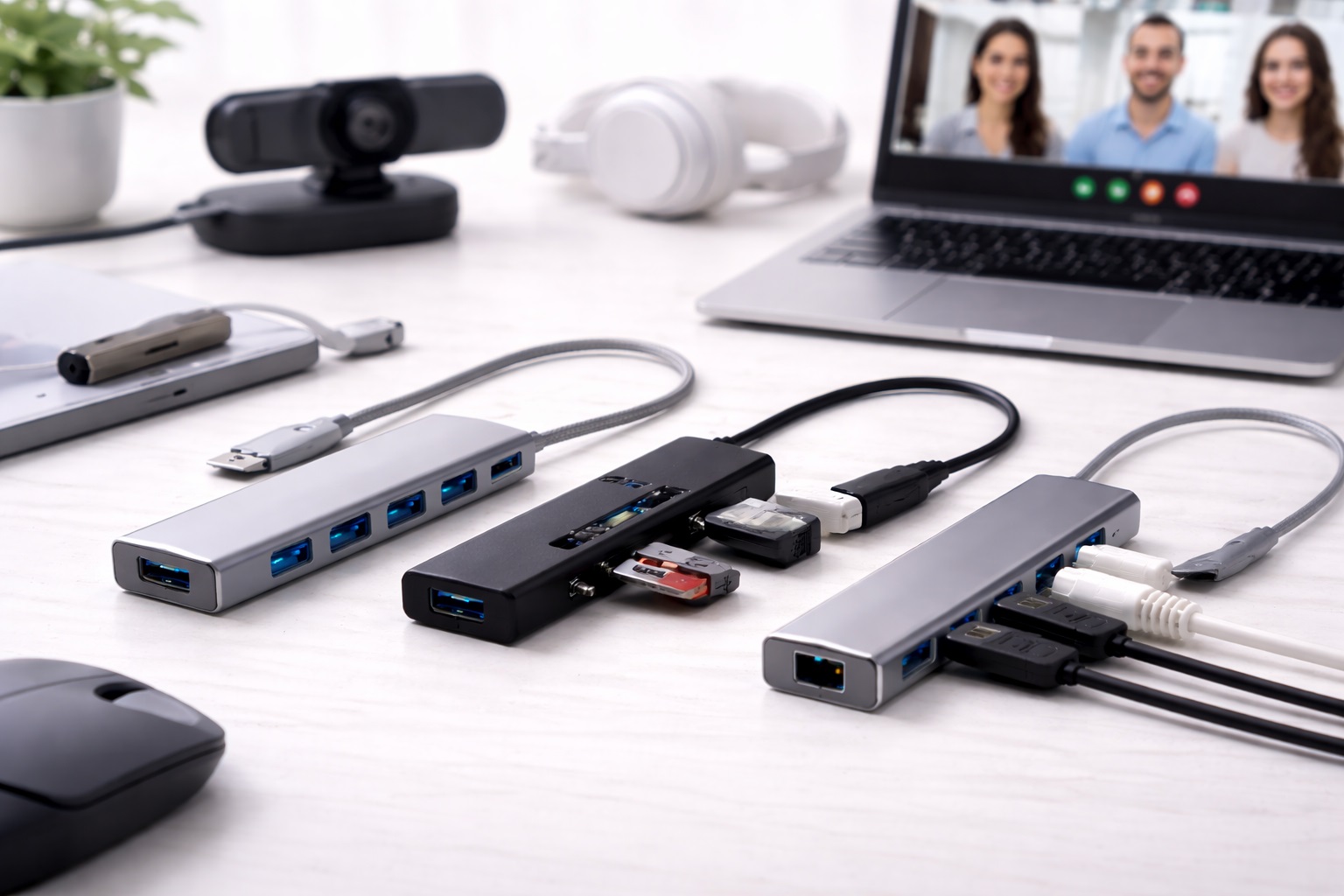
Best USB Hub for Calls in 2026: Seamless Connectivity for Every Meeting
In the digital-first professional landscape of 2026, virtual meetings are the heartbeat of business communication. However, a laptop with limited ports can quickly become a bottleneck when you need to connect a high-definition webcam, a professional microphone, a ring light, and an external monitor all at once. The **best USB hub for calls** is an essential piece of equipment that ensures your "presentation station" is reliable, high-speed, and free from the dreaded "device disconnected" notification in the middle of a pitch.
We've tested the latest hubs specifically for their stability and "noise-free" data transmission. we looked for models that provide enough power to run multiple high-bandwidth devices simultaneously without overheating or causing signal lag. Whether you're a remote executive, a customer success lead, or a digital nomad taking calls from a shared workspace, these are the top-rated USB hubs to keep your virtual presence professional and uninterrupted.
Top 8 Best USB Hubs for Professional Calls (Detailed Reviews)
1. Anker 555 USB-C Hub (8-in-1) – The Professional Standard
The Anker 555 is a masterpiece of reliability. For professional calls, its most important feature is the **stable 10Gbps USB-C data port**, which is perfect for high-end professional webcams that require high bandwidth. It also features a 4K@60Hz HDMI port, which ensures your secondary monitor (where you keep your notes or presentation) looks perfectly smooth. With its robust aluminum build and excellent heat management, it can run 4-hour meeting marathons without a single hiccup.
- Pros: Fast 10Gbps data ports, 4K@60Hz video, 100W Power Delivery, very high build quality.
- Cons: Integrated cable is a bit stiff, more expensive than basic models.
Who should buy this: Executives and presenters who need the absolute best stability for their high-end peripherals.
2. Satechi USB-C Multi-Port Adapter V2 – The Sleek Executive Choice
Satechi is famous for its Apple-matching aesthetics, but the V2 model is a performance beast. It features a dedicated **Ethernet Port**, which is the "secret weapon" for pro calls. Wi-Fi can drop, but a hardwired connection is perfectly stable. It also providing three USB-A ports for your microphone and mouse. Its slim design takes up very little space on your desk, and the aluminum finish keeps the electronics cool during long video streams.
- Pros: Includes Gigabit Ethernet, beautiful aluminum design, three USB-A ports, very reliable.
- Cons: 4K is limited to 30Hz, can get quite warm.
Who should buy this: Business professionals who want the security of a wired internet connection for their calls.
3. UGREEN Revodok Pro 210 (10-in-1) – The Multi-Monitor Master
If you take calls while juggling multiple spreadsheets and presentation decks, you need ports. The Revodok Pro 210 offers **Dual HDMI ports**, allowing you to run two extra monitors from one laptop plug. This allows you to have your video call on one screen, your notes on another, and your browser on the third. It features highnd data protection to ensure that plugging in a phone doesn't interfere with your webcam stream.
- Pros: Twin HDMI support, 10 total ports, very affordable for the features, high-speed charging.
- Cons: Larger footprint, requires a specific laptop to run two monitors at once.
Who should buy this: Analysts and project managers who need maximum screen real estate during their meetings.
4. Belkin Connect 7-in-1 USB-C Hub – The Reliability Workhorse
Belkin’s products are trusted by IT departments worldwide because they are built to universal standards. This 7-in-1 hub offers 100W PD charging, 4K HDMI, and two USB-A 3.0 ports. For a "call" setup, its best feature is the noise-shielded cable. Cheap hubs can sometimes cause "static" in your USB microphone because of electrical interference—Belkin’s high-quality shielding prevents this, ensuring you sound crystal clear to your audience.
- Pros: Superior electrical shielding (no mic static), 2-year warranty, very flexible cable, 100W PD.
- Cons: Standard data speeds (5Gbps), only HDMI (no DisplayPort).
Who should buy this: Teachers and podcasters who want to ensure their audio quality is never compromised by their hub.
5. Kensington SD1600P Mobile USB-C Dock – The Office Standard
Kensington is the king of office equipment. The SD1600P is unique because it features an **integrated cable stowage** and provides a VGA port—essential if you find yourself presenting in older offices or conference rooms with legacy equipment. For modern calls, it provides pass-through charging for your laptop and 3.5mm audio support. It’s a dense, durable unit that stays exactly where you put it on the desk.
- Pros: Integrated cable is great for travel, includes VGA for old projectors, very stable on the desk.
- Cons: Larger than most travel hubs, lower number of USB ports (2).
Who should buy this: Corporate travelers who need to connect to both modern and legacy equipment in various offices.
6. HyperDrive SLIM 8-in-1 – The Minimalist’s Presentation Tool
The SLIM 8-in-1 is about the thickness of a smartphone. It slides into the smallest pockets of a laptop bag. Despite its size, it includes a "Flip-open" Gigabit Ethernet port and 4K@60Hz HDMI. It features 3 USB-A ports, making it easy to connect your mouse, a ring light, and a webcam. It is the perfect choice for the digital nomad who needs to set up a professional call station in a small cafe or a co-working booth.
- Pros: Thinnest full-feature hub, 4K@60Hz support, includes Ethernet, very lightweight.
- Cons: Gets hot due to its small size, more expensive than rivals.
Who should buy this: Digital nomads and minimalists who want a full pro-call setup in a tiny bag.
7. Baseus 8-in-1 USB-C Hub with Digital Display – The Smart Monitor
Baseus has added a clever feature to this hub: a small **Digital Wattage Display** that shows you exactly how much power your laptop is receiving. This is helpful for ensuring your webcam and light aren't draining your battery faster than your charger can fill it. It features HDMI, SD slots, and three USB ports. It’s finished in a high-density aluminum that looks very high-tech on a modern workspace.
- Pros: Real-time power monitoring, very affordable, many ports, sleek high-tech look.
- Cons: 4K is only 30Hz, the screen is small.
Who should buy this: Tech enthusiasts who want to monitor their equipment's power intake during long work sessions.
8. JLab Go Wireless Mouse & USB Hub Kit – The Integrated Solution
If you're starting from scratch, JLab offers a combined hub and mouse kit. The hub is a simple, effective tool with HDMI and three USB-A ports. Because it’s part of the same "ecosystem," your JLab mouse or webcam will work flawlessly with it. It’s the most affordable way to get a perfectly functioning call desk set up in minutes without worrying about compatibility issues.
- Pros: No setup complexity, very affordable, includes a mouse, stable connection.
- Cons: Basic features only, plastic build, no Ethernet.
Who should buy this: New remote workers and students who want a simple "all-in-one" solution for their desk.
Buying Guide: Optimizing Your Call Station
When your livelihood depends on your virtual presence, your equipment matters. Here are the four things to check before you buy:
1. Ethernet is Still King
Even the fastest 5G or Wi-Fi 7 can have "jitter" or lag when the neighbors start streaming movies. If your work involves high-stakes calls, look for a hub with a **Gigabit Ethernet Port**. Plugging into your router directly is the only way to ensure your video doesn't "freeze" at the worst moment.
2. Power Delivery (PD) Pass-Through
Video calls are incredibly intensive for your laptop’s CPU and battery. You must have a hub with **"Power Delivery" (PD)**. This allows you to plug your laptop's charging cable into the hub, which then powers both the hub's accessories and your laptop. Look for 100W PD to ensure your laptop doesn't drain while you work.
3. Thermal Performance (Heat)
Webcams and external monitors generate a lot of data, which creates heat in the hub's processor. A cheap plastic hub can "Thermal Throttle" (slow down) when it gets too hot, causing your webcam to look choppy. **Aluminum Hubs** act as a giant heat sink, keeping your data speeds high even during 2-hour meetings.
4. USB-A vs. USB-C Port Mix
Most professional microphones and mice still use **USB-A** (the regular rectangular plug). Most new high-end webcams use **USB-C** (the small oval plug). Ensure your hub has at least **Two USB-A ports** and **One USB-C data port** so you don't need even more adapters!
FAQ: Expert Tips for Clearer Calls
Why is my microphone "buzzing" when I use a USB hub?
This is often due to "Ground Loop" interference or poor shielded cables. Try plugging your microphone into the USB port furthest away from the charging (PD) port on the hub. If it persists, you may need a hub with better electrical shielding, like the **Belkin or Anker** models.
Can I use my phone as a webcam through the hub?
Yes. If you have a phone that supports "C-to-C" video and a hub with a USB-C data port, you can use apps like Camo or the built-in "Continuity Camera" on Mac to turn your phone into a pro-grade webcam while it stays charged through the hub.
How many monitors can I connect to one hub?
Most budget hubs only support **One monitor (HDMI)**. If you need two or three, you must look for a specialized hub like the **UGREEN Revodok Pro** or a full "Thunderbolt Docking Station." Note that some laptops (like the base model M1/M2/M3 MacBook Air) only support one external monitor regardless of the hub.
Is "4K@30Hz" okay for video calls?
Yes. Zoom and Teams usually stream at 1080p or 720p at 30 frames per second. A 30Hz hub is perfectly adequate for the call itself. However, your **mouse movement** on that screen will feel "laggy." For a professional, 60Hz is always the better choice for a smooth workflow.
Do I need to unplug the hub when I'm not using it?
It’s recommended. Hubs pull a small amount of electricity even if nothing is attached. Over a weekend, a hub plugged into a sleeping laptop can drain the battery. Plus, unplugging it helps prevent any unexpected "wake-up" cycles for your connected monitors.
Final Verdict: The Best Winner for Your Meetings
- The Gold Standard: The Anker 555 for its speed, stability, and professional 60Hz video.
- The Executive Choice: The Satechi V2 for its beautiful design and essential Ethernet port.
- The Value Monster: The Baseus 8-in-1 for its price, ports, and power monitoring display.
Your digital image is your professional calling card. By choosing a high-quality USB hub, you're making your workday smoother, your presentations clearer, and your professional life more efficient. Don't let a missing port stand in the way of your next big win!